
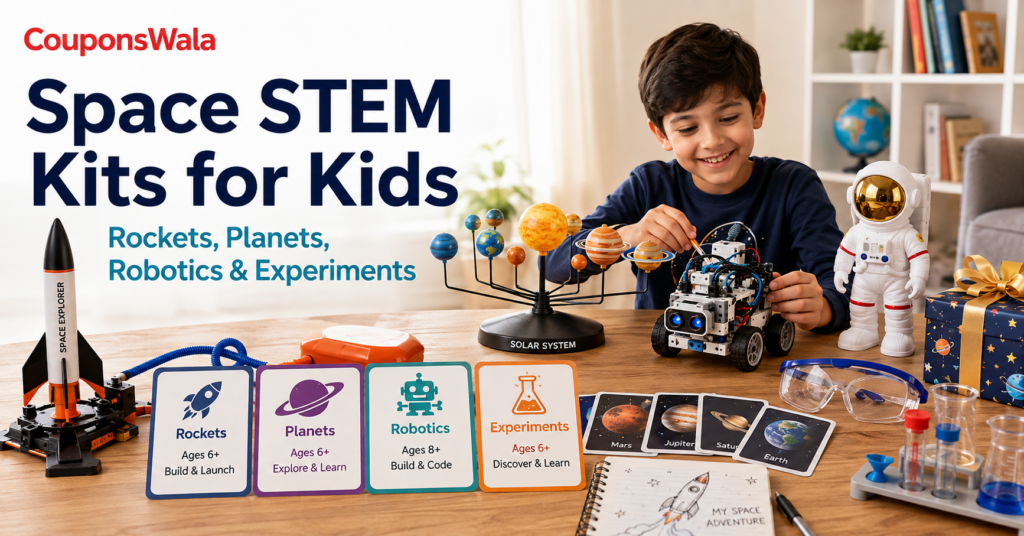
Quick Answer: The best space STEM kit for kids depends on age and skill level. Choose rocket science kits for hands-on physics, solar system kits for planet learning, robotics kits for engineering skills, astronomy kits for sky curiosity and experiment kits for science basics. For most kids aged 6–14, a build-and-test kit is better than a simple display toy because it teaches cause, effect, design and problem-solving.
- Best for ages 4–6: Simple planet puzzles, space blocks and large-piece solar system toys.
- Best for ages 6–10: Rocket launcher kits, solar system models and basic science experiment kits.
- Best for ages 8–14: Robotics kits, solar-powered space kits, astronomy kits and advanced model-building sets.
- Must check: Age rating, small parts, instructions, learning outcome, parent help needed and return policy.
Last Updated: August 2026
Table Of Content
- Space STEM Kits for Kids: Quick Recommendation Table
- What Is a Space STEM Kit?
- Best Space STEM Kits by Age
- Best Space STEM Kit Types
- Space STEM Kit Price Guide in India
- Best Space STEM Kits by Skill
- Store-Wise Buying Guide for Space STEM Toys
- How to Choose the Best Space STEM Kit
- Space STEM Kit Safety Checklist
- Space STEM Kit vs Space Toy: What Should You Buy?
- Best Space STEM Gift Combos
- Common Buying Mistakes to Avoid
- How to Save More on Space STEM Kits
- Final Verdict: Which Space STEM Kit Should You Buy?
- FAQs on Space STEM Kits for Kids
- Sources and Shopping Notes
Space STEM Kits for Kids: Quick Recommendation Table
| Child’s Interest | Best Space STEM Kit | Learning Skill | Buying Tip |
|---|---|---|---|
| Rockets and launching | Rocket science kit or rocket launcher kit | Force, motion, pressure, angle and distance | Choose kits with repeatable experiments and safe launch design. |
| Planets and solar system | Solar system model kit | Planet order, orbit, scale and astronomy basics | Pick working or 3D models over flat posters for better engagement. |
| Robots and engineering | Solar robot or space robotics kit | Assembly, gears, circuits, solar energy and design thinking | Check if tools, screws and instructions are included. |
| Stars and astronomy | Astronomy kit, telescope starter kit or constellation activity kit | Sky observation, Moon phases, stars and constellations | Match the kit with the child’s patience and age. |
| Science experiments | General science kit with space-themed activities | Observation, testing, cause and effect | Better for kids who enjoy multiple small experiments. |
What Is a Space STEM Kit?
A space STEM kit is a learning toy or activity kit that teaches science, technology, engineering and mathematics through space-themed projects. It may include rockets, planets, solar system models, robotics, telescopes, experiments, circuits, building blocks or astronomy activities.
The best kits are not only “space-looking” toys. A good STEM space toy should make the child build, test, observe, compare, adjust and learn. For example, a rocket launcher kit can teach force and angle. A solar system kit can teach orbit and planet order. A robotics kit can teach assembly and mechanical movement.
For planet-specific learning, also read our solar system model kit guide. For rocket-only gifts, check our best rocket toys for kids guide.
Best Space STEM Kits by Age
| Age Group | Best Kit Type | Skill Level | Parent Note |
|---|---|---|---|
| 4–6 years | Large-piece space puzzles, planet blocks, simple solar system toys | Beginner | Avoid tiny parts and complex experiments. |
| 6–8 years | Rocket launcher kit, basic science experiment kit, solar system craft kit | Easy to medium | Parent help may be needed for setup and explanation. |
| 8–10 years | Working solar system model, astronomy kit, beginner robotics kit | Medium | Choose kits with clear instructions and repeatable activities. |
| 10–12 years | Rocket science kit, solar robot kit, circuit-based space kit | Medium to advanced | Good age for testing, measuring and comparing results. |
| 12–14 years | Advanced robotics, telescope starter kit, model rocket or engineering kit | Advanced beginner | Choose kits with real learning depth, not only assembly. |
Best Space STEM Kit Types
1. Rocket Science Kit
A rocket science kit is one of the best STEM gifts because it turns physics into a visible activity. Kids can understand launch angle, air pressure, distance, balance and design changes through repeated tests.
- Best for: Ages 6–12 and kids who like action-based learning.
- Skills taught: Motion, force, pressure, angle, testing and improvement.
- Check before buying: Launch safety, included parts, reset ease and outdoor/indoor use.
For a deeper rocket buying guide, read our rocket ship toy buying guide and Estes rocket kit for beginners guide.
2. Solar System Model Kit
A solar system model kit is best for kids who ask questions about planets, Moon, Sun and space. A working model or DIY build kit is better than a simple poster because children can see planet order and orbit structure more clearly.
- Best for: School projects, science fairs and kids aged 8–14.
- Skills taught: Astronomy basics, planet order, orbit, scale and model-making.
- Check before buying: Build quality, instructions, stand stability and included paints or labels.
3. Space Robotics Kit
A space robotics kit works well for kids who like building, moving parts, solar energy and engineering. Some kits turn into different robot forms, while others focus on circuits, gears or solar-powered motion.
- Best for: Ages 8–14 and kids interested in machines.
- Skills taught: Mechanical assembly, circuits, solar power, robotics and problem-solving.
- Check before buying: Screwdriver, motor, solar panel, battery needs and difficulty level.
4. Astronomy Kit for Kids
An astronomy kit can include constellation cards, Moon phase activities, star charts, small telescope accessories or space observation projects. These kits are best for children who enjoy looking at the sky and asking “what is that star?”
- Best for: Curious kids, beginners and family night-sky activities.
- Skills taught: Observation, pattern recognition, Moon phases and sky awareness.
- Check before buying: Activity depth, age match and whether it includes real observation tasks.
For older kids who want real sky viewing, compare with our best telescope for beginners guide.
5. Space Building Blocks and LEGO-Style Kits
Space building kits are good for kids who enjoy construction. They may include rockets, satellites, Mars rovers, astronauts, space stations or shuttles. These are more toy-like, but they can still teach planning, spatial skills and patience.
- Best for: Kids who like building models and display toys.
- Skills taught: Following instructions, hand-eye coordination, design and patience.
- Check before buying: Piece count, age rating, missing-piece support and choking warnings.
For collectible-style options, see our LEGO NASA sets guide.
Space STEM Kit Price Guide in India
| Price Range | What You Usually Get | Best For | Buying Advice |
|---|---|---|---|
| Under ₹500 | Simple space puzzles, small craft kits, basic science toys | Return gifts and trial purchases | Check size, piece count and age rating carefully. |
| ₹500–₹1,000 | Rocket launcher kits, basic STEM toys, small solar models | Most budget gift buyers | Best value range for beginner STEM gifts. |
| ₹1,000–₹2,000 | Better science kits, robotics kits, solar system models | Birthdays and school project support | Check if the kit has multiple activities or one-time assembly. |
| ₹2,000–₹5,000 | Premium robotics, branded STEM kits, telescope starter products | Serious hobby interest | Buy only if learning depth and durability justify the price. |
| ₹5,000+ | Advanced models, telescope kits, premium robotics and collectible sets | Older kids and long-term STEM interest | Compare with real educational value before paying premium. |
Best Space STEM Kits by Skill
| Skill Goal | Best Kit | Why It Helps |
|---|---|---|
| Physics basics | Rocket launcher or rocket science kit | Shows force, angle, pressure and distance in a fun way. |
| Astronomy learning | Solar system model or astronomy kit | Helps kids understand planets, Moon, stars and orbits. |
| Engineering | Space building kit or robotics kit | Teaches assembly, structure, gears and problem-solving. |
| Robotics | Solar robot or multi-model robot kit | Introduces motion, power source and mechanical design. |
| Creative learning | Planet painting, space craft or DIY model kit | Mixes art, science and presentation skills. |
| Observation | Astronomy cards, telescope starter kit or Moon phase kit | Encourages sky watching and real-world curiosity. |
Store-Wise Buying Guide for Space STEM Toys
| Store Type | Best For | What to Check | Saving Tip |
|---|---|---|---|
| Amazon | Wide variety of STEM kits, science kits, robot kits and gift options | Age rating, reviews, seller rating, return policy and real photos | Check coupons, bank offers and lightning deals. |
| Flipkart | Budget STEM toys, rocket kits, solar robots and construction kits | Final buy price, replacement period, piece count and brand details | Compare sale price with similar age-rated kits. |
| Educational Toy Brands | Better instructions, structured learning and age-specific kits | Learning outcome, difficulty level and support | Check first-order coupons or bundle offers. |
| Bookstores and School Stores | Science project kits and activity boxes | Curriculum relevance, manual quality and material safety | Good for school project season. |
| Gift Stores | Curated space gifts and birthday combos | Packaging, delivery date and return policy | Buy during birthday, festive and children’s sale events. |
Before checkout, check sale timing through our Amazon upcoming sale and Flipkart upcoming sale list.
How to Choose the Best Space STEM Kit
1. Match the Age Rating
Do not buy only by product photos. A kit may look simple but include tiny screws, wires, sharp edges or difficult instructions. Always check the recommended age on the product page.
2. Check the Learning Outcome
A good space STEM kit should teach something clear. Look for kits that explain motion, planets, circuits, solar energy, engineering design or astronomy concepts.
3. Choose Repeatable Activities
Some kits are built once and then kept aside. Better STEM kits allow kids to test, rebuild, modify or repeat the activity.
4. Check Parent Help Needed
Younger kids may need adult help for cutting, assembling, launching, wiring or reading instructions. Choose independent kits only for children who can follow steps safely.
5. Check Build Quality
Weak plastic, unclear instructions or missing parts can ruin the STEM experience. Real reviews and customer photos are very useful here.
6. Check Safety Details
For younger children, avoid tiny parts, small magnets, sharp tools, chemical experiments or launch toys without supervision.
Space STEM Kit Safety Checklist
Safe Buying Tips for Parents
- Check the age label before buying any STEM kit.
- Keep small parts away from children under 3.
- Supervise rocket launchers, elastic mechanisms and pressure-based toys.
- Check whether batteries, magnets, screws or tools are included.
- Avoid chemical kits unless the child is old enough and adult supervision is available.
- Read the instruction manual before the child starts using the kit.
- Store unused parts safely after the activity.
- Check return and replacement policy for missing parts.
Space STEM Kit vs Space Toy: What Should You Buy?
| Product Type | Best For | Choose It If |
|---|---|---|
| Space STEM Kit | Learning, experiments and hands-on building | You want the child to learn while playing. |
| Rocket Toy | Action play and quick fun | You want simple play without much setup. |
| Solar System Model | School projects and planet learning | You want visual astronomy learning. |
| LEGO-Style Space Set | Construction and display | The child likes building and collecting models. |
| Telescope | Real sky observation | The child is ready for outdoor astronomy learning. |
Best Space STEM Gift Combos
| Gift Combo | Best For | Why It Works |
|---|---|---|
| Rocket kit + space book | Kids who love launch experiments | Combines activity with explanation. |
| Solar system model + glow stars | Bedroom learning corner | Turns the room into a space-themed learning area. |
| Robotics kit + circuit kit | Engineering-minded kids | Builds mechanical and electrical understanding. |
| Astronomy kit + beginner telescope | Older space lovers | Connects indoor learning with real sky observation. |
| Space STEM kit + moon lamp | Birthday gifting | Mixes learning gift with bedroom decor. |
For decor add-ons, read our glow in the dark stars for ceiling guide and rechargeable moon lamp guide.
Common Buying Mistakes to Avoid
1. Buying a Toy That Looks Educational but Has No Activity
Some products look like STEM toys but only work as simple display toys. Check whether the child actually builds, tests or experiments with the product.
2. Ignoring Age and Skill Level
A kit that is too easy becomes boring. A kit that is too difficult creates frustration. Match the kit to the child’s age, patience and interest.
3. Not Checking Small Parts
Many STEM kits include tiny screws, gears, connectors, magnets or plastic parts. These are not suitable for very young children.
4. Buying One-Time Kits at Premium Prices
Some kits are used once and then ignored. Better kits offer multiple builds, repeated experiments or long-term display value.
5. Missing Replacement Policy
A missing screw, broken connector or damaged part can stop the entire activity. Check replacement and return policy before buying.
6. Choosing Only by Discount
A cheap kit is not a good deal if instructions are poor, parts are weak or learning value is low. Compare quality first, then coupon price.
How to Save More on Space STEM Kits
- Choose the age group and skill level before browsing deals.
- Compare rocket, solar system, robotics and science experiment kits by learning outcome.
- Check whether the kit includes all tools, batteries, screws and instructions.
- Use coupons, bank offers and sale events before checkout.
- Buy combo packs only when all included kits are useful.
- Prefer repeatable kits over one-time craft activities for better value.
- Check CouponsWala offer pages before placing the order.
Final Verdict: Which Space STEM Kit Should You Buy?
For ages 6–8, choose a rocket launcher or simple solar system activity kit. For ages 8–10, choose a working solar system model, astronomy kit or beginner robotics kit. For ages 10–14, choose rocket science kits, solar robots, circuit kits or telescope starter options.
The best space STEM kit is not just the most colourful or expensive one. Choose the kit that matches the child’s age, attention span, safety needs and learning goal. A good kit should make the child build, test, think and ask the next question.
FAQs on Space STEM Kits for Kids
1. What is the best space STEM kit for kids?
The best space STEM kit depends on age and interest. Rocket kits are best for physics, solar system kits are best for astronomy basics, and robotics kits are best for engineering skills.
2. What age is best for space STEM kits?
Basic space kits can work from age 4–6 with adult help. More useful STEM kits usually start around age 6+, while robotics and advanced astronomy kits are better for ages 8–14.
3. Are rocket science kits safe for kids?
They can be safe when age guidance is followed and adults supervise launch-based activities. Avoid strong launch mechanisms for very young children.
4. Which is better: solar system kit or rocket kit?
A solar system kit is better for planet learning and school projects. A rocket kit is better for action-based learning and physics concepts.
5. Are space STEM kits good gifts?
Yes, they are strong gifts because they combine play, learning and hands-on activity. Choose based on the child’s age and interest.
6. What should I check before buying an astronomy kit for kids?
Check age rating, activity depth, included materials, instructions, parent help needed, small parts and whether the kit supports real observation or only decoration.
7. How can I save money on space STEM toys?
Compare age rating, learning value, piece count and final checkout price across stores. Use coupons, sale events and bank offers before buying.