
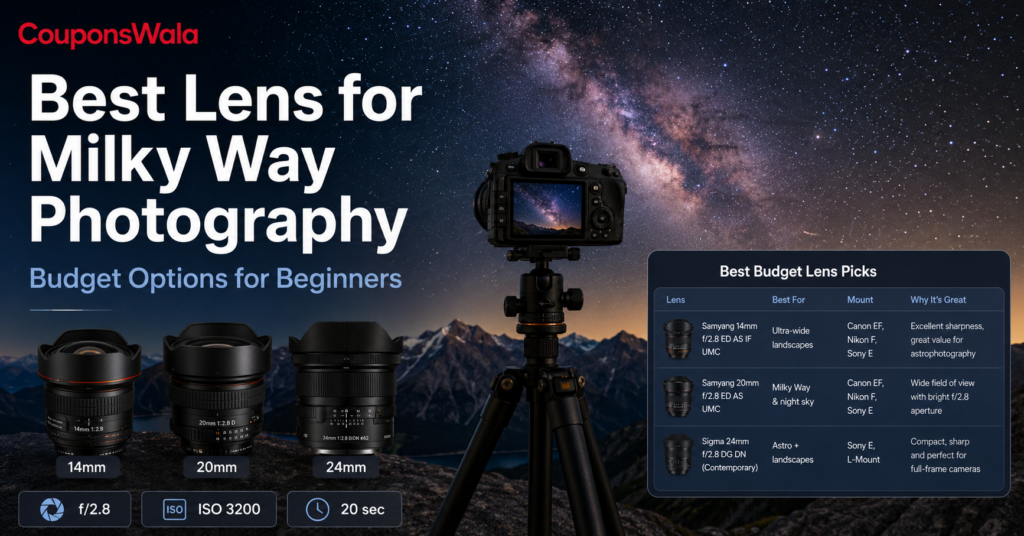
Quick Answer: The best Milky Way photography lens for beginners is a wide-angle lens with a bright aperture. On full-frame cameras, 14mm, 20mm and 24mm lenses work well. On APS-C cameras, 10mm, 11mm, 13mm and 16mm lenses are better because crop factor makes them look tighter. For most beginners, choose a 14mm f/2.8, 16mm f/1.4 APS-C lens, 20mm f/1.8 or budget 24mm f/1.8/f/2.8 lens depending on your camera mount.
- Best full-frame budget pick: 14mm f/2.8 manual or autofocus wide-angle lens.
- Best APS-C pick: 13mm f/1.4 or 16mm f/1.4 lens.
- Best premium pick: 20mm f/1.8 or 14–24mm f/2.8 lens.
- Must check: Camera mount, aperture, coma control, manual focus feel, filter support and live deal price.
Last Updated: August 2026
Table Of Content
- Milky Way Photography Lens: Quick Recommendation Table
- Valid Lens Deals Table: Check Live Price Before Buying
- What Makes a Lens Good for Milky Way Photography?
- Best Focal Lengths for Milky Way Photography
- Best Lens Types by Budget
- Milky Way Photography Settings for Beginners
- 500 Rule: Simple Shutter Speed Formula
- 14mm vs 24mm Lens for Milky Way
- Essential Night Sky Photography Gear
- Where to Buy Milky Way Photography Lenses Online
- Buying Mistakes to Avoid
- How to Save More on Milky Way Photography Gear
- Final Verdict: Which Milky Way Lens Should Beginners Buy?
- FAQs on Milky Way Photography Lens
- Sources and Shopping Notes
Milky Way Photography Lens: Quick Recommendation Table
| Camera Type | Best Focal Length | Best Aperture | Beginner Verdict |
|---|---|---|---|
| Full-frame DSLR / Mirrorless | 14mm, 20mm or 24mm | f/1.8 to f/2.8 | 14mm captures more sky; 20mm/24mm gives cleaner composition. |
| APS-C DSLR | 10mm, 11mm or 16mm | f/1.4 to f/2.8 | Choose ultra-wide because crop factor makes the frame tighter. |
| APS-C Mirrorless | 13mm or 16mm | f/1.4 to f/2 | Best value for Sony E, Fuji X, Nikon Z DX and Canon RF-S users. |
| Micro Four Thirds | 7mm to 12mm | f/1.4 to f/2.8 | Go wider because of 2x crop factor. |
| Kit Lens User | 18mm or widest available | f/3.5 or widest available | Usable for learning, but upgrade to faster wide-angle lens later. |
Valid Lens Deals Table: Check Live Price Before Buying
Lens prices change quickly during sale events, bank offers and stock changes. Use this table as a live deal shortlist and verify the final checkout price before buying.
| Lens / Deal Link | Best For | Seen Price / Deal Note | Why It Fits Milky Way Photography | Buyer Warning |
|---|---|---|---|---|
| Canon RF 16mm f/2.8 STM | Canon RF full-frame and RF-S users | Seen at ₹27,300 vs ₹29,495 on JJ Mehta | Compact ultra-wide full-frame lens with f/2.8 aperture; good budget Canon RF option. | Check stock and whether your camera is full-frame RF or APS-C RF-S. |
| Sigma 16mm f/1.4 DC DN Contemporary Canon RF | Canon RF APS-C users | Seen at ₹36,000 vs ₹48,100 on JJ Mehta | Bright f/1.4 aperture helps gather more light; strong pick for APS-C night sky beginners. | Designed for APS-C; not the same as a full-frame 16mm field of view. |
| Sigma 16mm f/1.4 DC DN Sony E | Sony APS-C mirrorless users | Seen at ₹44,250 on Sigma India listing | Popular fast APS-C wide prime for low-light, stars and travel night photography. | On APS-C, field of view feels like around 24mm full-frame equivalent. |
| Viltrox AF 13mm f/1.4 E Mount | Sony APS-C users who want wider frame | Seen at ₹39,999 vs ₹59,000 on Design Info | 13mm is wider than 16mm on APS-C and f/1.4 is helpful for dark skies. | Check exact mount and real-world corner performance before buying. |
| Tokina atx-i 11-16mm f/2.8 CF | Canon EF / Nikon F APS-C DSLR users | MRP seen at ₹42,990 on Foto Centre | Ultra-wide zoom with constant f/2.8; useful for APS-C DSLR night landscapes. | Check Canon EF vs Nikon F mount before checkout. |
| Samyang AF 14mm f/2.8 | Full-frame Canon, Nikon and Sony users | Seen at ₹55,000; best-buy ₹53,900 on Sharp Imaging | 14mm full-frame view captures wide Milky Way arcs and foreground landscapes. | Check AF/MF version, mount and coma reviews before buying. |
| Sony FE 20mm f/1.8 G | Sony full-frame users | Seen at ₹79,990 vs ₹91,490 on Sony ATSC | Premium 20mm f/1.8 option for sharp night-sky, landscape and travel astro work. | Higher budget; buy only if you shoot night sky often. |
| Nikon Z 24mm f/1.8 S | Nikon Z full-frame users | Seen at ₹77,990; buy-at price shown around ₹73,615 on Flipkart | Bright 24mm f/1.8 lens for Milky Way, travel, landscape and low-light scenes. | 24mm is less wide than 14mm/20mm; watch shutter speed to avoid trails. |
What Makes a Lens Good for Milky Way Photography?
A good Milky Way photography lens should capture a wide sky area and allow enough light in a short exposure. That is why wide-angle lenses with fast apertures are preferred. A 14mm f/2.8 lens can capture a larger sky view, while a 20mm f/1.8 or 24mm f/1.8 lens gathers more light but needs more careful framing.
- Wide focal length: Helps capture more sky and foreground.
- Fast aperture: f/1.4, f/1.8, f/2 or f/2.8 gathers more light.
- Low coma: Stars should look like points, not birds or smears in corners.
- Manual focus control: Important because autofocus is unreliable in dark skies.
- Mount compatibility: Canon RF, Sony E, Nikon Z, Fuji X, Canon EF and Nikon F are not interchangeable without adapters.
If you are still choosing the observation side of astronomy, read our best telescope for beginners guide and telescope price in India guide.
Best Focal Lengths for Milky Way Photography
| Focal Length | Best For | Beginner Advice |
|---|---|---|
| 14mm | Wide Milky Way arcs, foreground landscapes, full sky scenes | Best if you want maximum sky coverage on full-frame. |
| 16mm | Wide landscapes and beginner astro scenes | Great on full-frame; on APS-C it behaves closer to 24mm equivalent. |
| 20mm | Balanced sky + foreground compositions | Excellent premium focal length if aperture is f/1.8 or f/2. |
| 24mm | Cleaner compositions, landscapes, travel astro | Good with f/1.4 or f/1.8, but shutter speed must be shorter. |
| 35mm+ | Tracked shots, panoramas and advanced work | Not ideal for beginners unless using a star tracker. |
Best Lens Types by Budget
1. Budget Beginner Lens
Choose this if you are just starting and want to learn Milky Way settings without spending too much. Canon RF 16mm f/2.8, used 14mm f/2.8 lenses or APS-C wide-angle lenses can be good entry points.
- Best for: First Milky Way trip, budget night sky attempts, travel users.
- Look for: f/2.8 or faster, wide focal length, reliable manual focus.
- Avoid: Slow f/4–f/5.6 lenses unless you only want to practice.
2. APS-C Value Lens
APS-C users should go wider than they think. A 16mm lens on APS-C behaves closer to a 24mm full-frame view. That is why 11mm, 13mm and 16mm fast primes or ultra-wide zooms are useful.
- Best for: Sony A6000 series, Canon R50/R10, Nikon Z50/Zfc, Fuji X users.
- Look for: 13mm f/1.4, 16mm f/1.4 or 11–16mm f/2.8.
- Avoid: Buying a full-frame lens without understanding crop factor.
3. Premium Full-Frame Lens
If you shoot landscapes, travel and Milky Way often, a premium 20mm f/1.8, 24mm f/1.8 or 14–24mm f/2.8 lens is worth considering. These cost more, but usually offer better sharpness, autofocus and build quality.
- Best for: Serious night landscape photographers.
- Look for: f/1.8, weather sealing, low coma and sharp corners.
- Avoid: Paying premium only for brand name without checking sample images.
Milky Way Photography Settings for Beginners
Use these as starting points, then adjust based on your camera, sky darkness, moon phase and light pollution.
| Lens | Aperture | Shutter Speed | ISO | Focus |
|---|---|---|---|---|
| 14mm f/2.8 full-frame | f/2.8 | 20–25 sec | ISO 3200–6400 | Manual focus on bright star |
| 20mm f/1.8 full-frame | f/1.8–f/2.2 | 15–20 sec | ISO 1600–3200 | Manual focus with magnified live view |
| 24mm f/1.8 full-frame | f/1.8–f/2.8 | 10–15 sec | ISO 3200 | Manual focus carefully |
| 16mm f/1.4 APS-C | f/1.4–f/2 | 10–15 sec | ISO 1600–3200 | Manual focus; check corners |
| Kit lens 18mm f/3.5 APS-C | f/3.5 | 10–15 sec | ISO 6400 | Manual focus; expect more noise |
500 Rule: Simple Shutter Speed Formula
The 500 rule is a beginner shortcut for estimating shutter speed before stars start trailing. Divide 500 by the full-frame equivalent focal length. For example, 500 ÷ 20mm gives about 25 seconds. For sharper stars, many photographers use a shorter exposure than the 500 rule suggests.
| Full-Frame Equivalent Lens | 500 Rule Result | Safer Beginner Shutter |
|---|---|---|
| 14mm | About 35 sec | 20–25 sec |
| 16mm | About 31 sec | 20 sec |
| 20mm | About 25 sec | 15–20 sec |
| 24mm | About 20 sec | 10–15 sec |
| 35mm | About 14 sec | 8–10 sec |
14mm vs 24mm Lens for Milky Way
| Comparison | 14mm Lens | 24mm Lens |
|---|---|---|
| Sky Coverage | Much wider | Tighter view |
| Foreground Composition | Great for landscapes and large scenes | Better for cleaner, focused composition |
| Shutter Speed | Allows longer exposure before trails | Needs shorter exposure |
| Beginner Friendly | Very forgiving for framing | Needs better planning |
| Best Use | Big Milky Way arc and foreground | Travel astro, vertical core shots and panoramas |
Essential Night Sky Photography Gear
- Wide-angle lens: 14mm, 16mm, 20mm or 24mm depending on camera.
- Sturdy tripod: More important than beginners think.
- Remote shutter or 2-sec timer: Reduces camera shake.
- Headlamp with red mode: Helps set up without ruining night vision.
- Extra batteries: Long exposures drain batteries faster.
- Memory cards: Shoot RAW for better editing flexibility.
- Weather protection: Useful for dew, dust and cold nights.
For broader beginner astronomy gear, check our best telescope under ₹5000 guide and best telescope under ₹10000 India guide.
Where to Buy Milky Way Photography Lenses Online
| Store Type | Best For | What to Check | Saving Tip |
|---|---|---|---|
| Official brand stores | Sony, Canon, Sigma and Nikon lenses with brand support | Warranty, stock, mount and official invoice | Check seasonal lens offers and EMI. |
| Camera retailers | JJ Mehta, Foto Centre, Sharp Imaging, Design Info, RetinaPix and similar stores | GST invoice, warranty, return policy and stock status | Ask for bundle price with filter, tripod or camera bag. |
| Amazon / Flipkart | Fast delivery, bank offers and price comparison | Seller rating, return window, warranty and exact mount | Use bank offers and track price drops before checkout. |
| Used gear marketplaces | Budget 14mm, 24mm and older DSLR lenses | Fungus, scratches, decentering, focus ring and bill | Meet in person or buy only with inspection support. |
Before buying expensive camera gear, also check Amazon upcoming sale and Flipkart upcoming sale list for bank offers and electronics sale timing.
Buying Mistakes to Avoid
1. Buying the Wrong Mount
A Canon RF lens will not directly fit Sony E, Nikon Z or Canon EF cameras. Always match your camera mount before checkout.
2. Choosing Only by Aperture
f/1.4 looks attractive, but corner quality, coma and focus accuracy also matter for stars.
3. Ignoring Crop Factor
APS-C cameras make lenses look tighter. A 16mm APS-C lens frames more like a 24mm full-frame lens.
4. Buying Too Long a Lens
35mm and 50mm lenses can shoot the Milky Way, but beginners will struggle with star trailing unless using a tracker or panorama method.
5. Skipping Manual Focus Practice
Autofocus often fails in dark skies. Practice focusing on a bright star using live view before your trip.
6. Trusting Only Discount Labels
A lens deal is not good just because it shows a big MRP cut. Compare live price, warranty, mount, seller rating and return policy.
How to Save More on Milky Way Photography Gear
- Confirm your camera mount before checking deals.
- Shortlist focal length first: 14mm, 16mm, 20mm or 24mm.
- Compare official store price with camera retailers and marketplaces.
- Check if the price includes India warranty and GST invoice.
- Use bank offers or EMI only when the final price is genuinely lower.
- Consider used lenses only after checking fungus, scratches and focus accuracy.
- Check CouponsWala offer pages before buying expensive lenses or accessories.
Final Verdict: Which Milky Way Lens Should Beginners Buy?
For full-frame beginners, a 14mm f/2.8 lens is the safest entry point if you want wide sky coverage. For APS-C mirrorless users, a 13mm f/1.4 or 16mm f/1.4 lens gives strong value. For serious Sony full-frame users, a 20mm f/1.8 is a premium but excellent choice. For Nikon Z users, 20mm f/1.8 or 24mm f/1.8 can work well if the budget allows.
The best Milky Way photography lens is not simply the cheapest wide-angle lens. Choose by mount, focal length, aperture, coma control, manual focus feel, warranty and final live deal price.
FAQs on Milky Way Photography Lens
1. What is the best lens for Milky Way photography?
The best lens for Milky Way photography is usually a wide-angle lens between 14mm and 24mm with an aperture of f/2.8 or wider.
2. Is 14mm good for Milky Way photography?
Yes, 14mm is excellent for Milky Way photography because it captures a wide sky area and allows longer shutter speeds before star trails become obvious.
3. Is 24mm good for Milky Way photography?
Yes, 24mm can work well, especially with f/1.4 or f/1.8 aperture. It needs shorter shutter speeds than 14mm, so focus and exposure must be more careful.
4. Can I shoot the Milky Way with a kit lens?
Yes, you can practice with a kit lens at its widest focal length and widest aperture, but results may be noisier and darker than a fast wide-angle lens.
5. What aperture is best for Milky Way photography?
f/1.4, f/1.8, f/2 and f/2.8 are common choices. Very fast lenses may need slight stopping down if corners show heavy coma.
6. What ISO should I use for Milky Way photography?
ISO 3200 is a common starting point. Adjust between ISO 1600 and 6400 depending on aperture, shutter speed, sky darkness and camera noise.
7. How can I save money on astrophotography lenses?
Buy the right mount, compare camera retailers, check sale prices, use bank offers, avoid unnecessary premium zooms and consider used lenses only after inspection.
Sources and Shopping Notes
- Nikon: How to Photograph the Milky Way
- Tamron: How to Photograph the Milky Way
- Adobe: Milky Way Photography
- JJ Mehta: Canon RF 16mm f/2.8 STM
- JJ Mehta: Sigma 16mm f/1.4 DC DN Canon RF
- Sigma India: Sigma 16mm f/1.4 DC DN Sony E
- Design Info: Viltrox AF 13mm f/1.4 E Mount
- Foto Centre: Tokina atx-i 11-16mm f/2.8 CF
- Sharp Imaging: Samyang AF 14mm f/2.8
- Sony ATSC: Sony FE 20mm f/1.8 G